Open-Battle Terms
Gang Up: A Bikerland NovelOpen-Battle Terms are the wartime conditions that shift the Family–Cauldron conflict from sneak attacks and slow encroachment to an openly contested battle outside town. They turn a broader plan to end the conflict into an immediate military confrontation, while leaving its outcome—and any settlement afterward—undetermined.
Context and Purpose
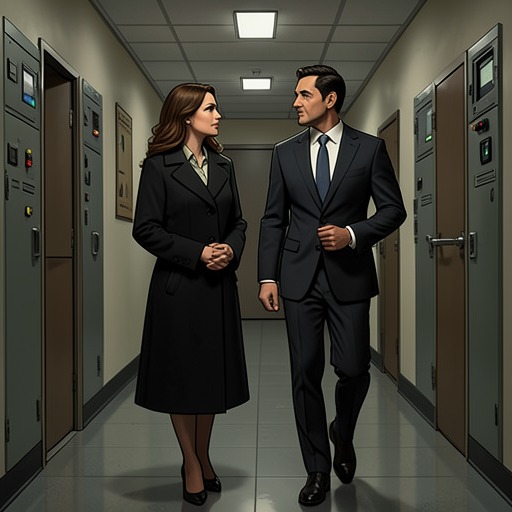
By the morning the terms were set, Case had discussed a plan with Troy through the night. On paper, that plan was to wipe Brall out; its larger purpose was to resolve the conflict once and for all. The terms therefore framed a decisive clash, not a negotiated peace. Their rejection of both surprise attacks and gradual consumption of territory marks a change in how the war would be fought, even as the proposed objective remained Brall’s complete defeat.
The stakes were also material. In an earlier fight, Brall’s forces took a stream fed by a cave, a source of clean water untouched by the land’s radiation. Control of it gave his side a significant advantage: the Family had other water sources, but none as nearby or readily available, and without steady water its position would weaken. That struggle illustrates why control of territory and resources mattered to the wider conflict, though the terms themselves do not specifically name the stream.
The Terms in Practice
The stated conditions were direct: no more sneak attacks and no more slow consumption of one side by the other. Instead, the sides would meet in the open, outside town, and fight it out. The account presents these as the terms of the war, but does not describe a written agreement, a procedure for enforcing them, or penalties for breaking them.
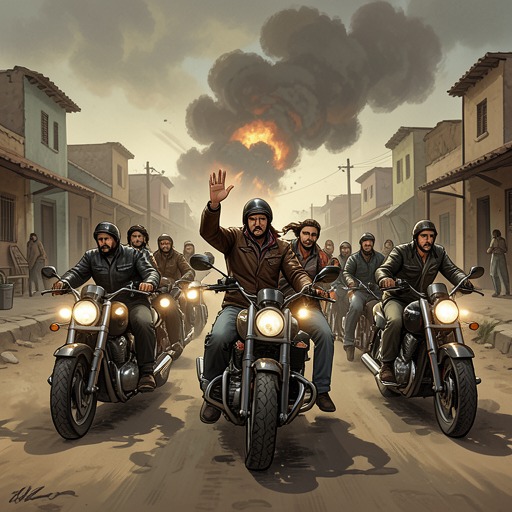
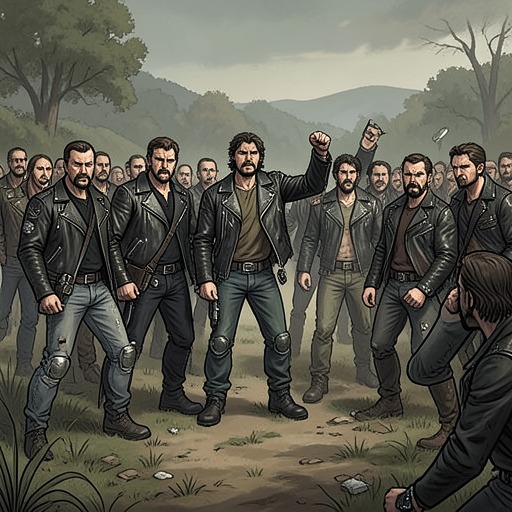
The change immediately took physical form in the assembly beyond the walls. Rows of motorcycles revved as the two sides raised their war cries; their fighters carried hatchets, planks, spikes, knives, chains, shotguns, and spears. The Family had perhaps half again as many people as the Cauldron. The gathering thus exposed an imbalance of numbers even as the terms required both forces to face one another in the open.
Participants and Consequences
Troy embraced the prospect of a melee, while the plan attributed to Case was aimed at eliminating Brall’s force and ending the conflict. The contrast matters: the same terms could serve a strategic attempt at final resolution and an immediate appetite for close combat. Both sides clamored for battle, so the open confrontation was not merely a rule announced from above; it became a visible and mobilized contest.
The evidence establishes the conditions and the gathering, not the battle’s result. Open-Battle Terms suspend the pattern of covert attacks and incremental pressure in favor of a direct test of force, but they do not show that the war is resolved, that either side accepts limits beyond those stated, or that victory will produce a durable settlement.